
Written by Jacob Brown | November 18, 2026 | SHARE


A forthcoming United Nations compendium will feature Lehigh researchers’ work on using artificial intelligence to better estimate losses from earthquakes.
A study from two members of Lehigh University’s Center for Catastrophe Modeling and Resilience explores how artificial intelligence can improve predictions of earthquake damage.
The study will appear in a compendium from the United Nations Office for Disaster Risk Reduction (UNDRR) featuring global case studies, policy evaluations, and emerging technology in disaster risk reduction.
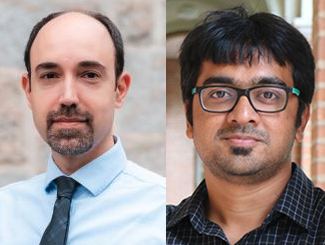
Paolo Bocchini is a professor and the program director, while Sushreyo Misra is a research scientist and adjunct professor. Bocchini is also one of 16 faculty members in the Lehigh University/United Nations (LU/UN) Partnership’s Faculty Fellows Program, which launched in 2025.
Bill Hunter, Director of the LU/UN Partnership, said the program includes faculty from all five colleges at Lehigh.
“Fellows have access to the UN for not only the conferences, briefings, and workshops, but the potential of truly impacting global policy,” Hunter said. “Lehigh now has the potential to put items on the UN agenda.”
Predicting earthquake losses
Misra and Bocchini developed MetaIMNet, a neural network that combines machine learning with engineering principles to identify patterns in earthquake data that conventional risk assessment methods may miss.
“The big difference is that we used our engineering understanding to design the architecture of the neural network,” Bocchini said. “It's a much stronger integration where we drive the neural network processing based on the logic that an engineer would use.”
The publication includes a case study examining how MetaIMNet could improve predictions of damage and losses to buildings affected by the devastating 1994 Northridge earthquake in Southern California.
“What we were able to show with this example was that through MetaIMNet, not only did the results become a more accurate depiction of the losses, but it's also more reliable,” Misra said. “The uncertainty coming out of MetaIMNet is also lower.”
While their research is potentially transformative, it doesn’t attempt to reinvent the wheel. For Misra and Bocchini, it was important to emphasize that this application of MetaIMNet is compatible with the current risk reduction industry.
“One of the concerns that we had is that we don't want to scare people with the notion that perhaps everything needs to change,” Bocchini said. “This technology can be introduced and used in practice, without having to revolutionize the rest of the risk assessment process.”
Building on the UN partnership
While the technology has not been used in practice yet, the partnership between Lehigh and the UN has brought that goal closer to fruition. With this publication, the study will gain exposure to policymakers and legislators all across the world.
The Center for Catastrophe Modeling and Resilience plans to continue its collaboration with UNDRR, particularly with UNDRR’s regional office for the Americas in Panama. Last year, the director of that office gave a guest lecture at Lehigh.
Now Bocchini is hoping to establish an internship program there.
“They see Lehigh as a partner because we have this credibility that comes from decades of work with the United Nations and what the LU/UN partnership has established,” Bocchini said. “At the same time, we have this credibility in catastrophe modeling through our research center. The ability to publish in this book that surveys applications of new technology to disaster risk reduction was born out of this partnership.”
Beyond earthquake risk
Another avenue of real-world application for the study is its potential to be used in other areas of risk assessment, especially wind engineering. Because wind forces can vary across different parts of tall and slender structures like transmission towers, MetaIMNet could help engineers develop more detailed estimates of the forces those structures experience.
The study’s “meta intensity measures”, which identify underlying features within earthquake signals, could outperform traditional intensity measures. The model could also generalize across different categories of earthquake problems, suggesting that its results are not limited to the specific examples used during training.
“What we find is that these meta intensity measures are fairly generalizable,” Misra said. “We can train it on a certain class of problems, and when you test it on a different class of problems, it still does reasonably well. That gives us a promise that this approach in general can be used for other types of problems such as in wind engineering.”
For now, their research focuses on earthquake risk assessment, but the UN publication will feature a variety of different studies covering the policy and implementation of resilient risk assessment technology. Misra and Bocchini’s study will be one chapter in the larger compendium, but one that they are proud of.
“I think that's a really commendable initiative, and it was an honor to see our work among the others that are in the volume,” Bocchini said.