Written by Julia Swill | December 17, 2025 | SHARE


A Lehigh graduate applies sustainability research, global experience, and public service to environmental justice work in Pennsylvania.
Through a Governor's Science and Technology Fellowship, John Roper, a recent graduate of Lehigh University's Master of Environmental Policy Design program, is now advancing environmental justice, working at the Pennsylvania Department of Environmental Protection (DEP).

Roper's journey began with encouragement from Bill Hunter, Lehigh's Director of Fellowship Advising and UN Programs. After taking Hunter's sustainable development course during his first semester at Lehigh, Roper caught Hunter's attention with his research at the Catastrophe Modeling Center, which examined the intersection of social vulnerability and climate change.
“He really got me connected with some of the fellowships,” Roper said. “He wanted me to take a look at the Fulbright, the Rhodes, and a couple other ones.”
During his time at Lehigh, Roper contributed to the Lehigh University/United Nations (LU/UN) Partnership through the Greening of the UN team.
Roper said he realized coming out of undergrad that much experience with hard skills and sustainability science, but he hadn’t done an actual sustainability assessment of a building and the greening process.
He worked with missions from Germany, the Kingdom of the Netherlands, and Canada to conduct sustainability assessments of their mission buildings.
“We look at the carbon emissions and the energy usage of mission buildings,” Roper said.
The team would inventory appliances and lighting, then calculate how much carbon the missions were emitting and how much they could save if they made a couple of tweaks.
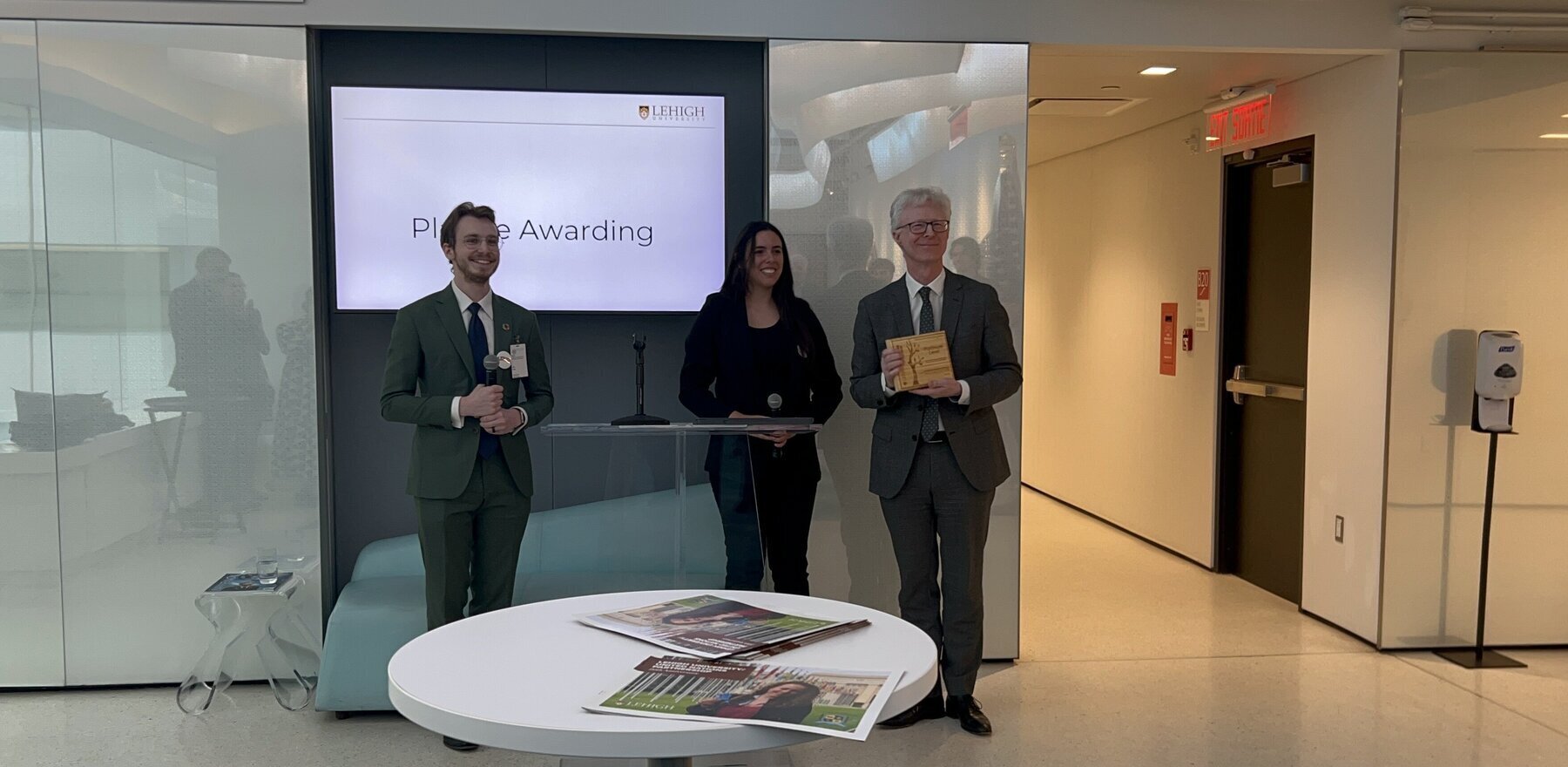
He also presented at a United Nations Academic Impact event focused on scalable solutions for localizing the Sustainable Development Goals (SDGs).
With changing political priorities affecting climate science funding, Roper felt fortunate to secure the DEP position.
“I definitely saw that there was a mass de-prioritization of climate science and science in general,” he said. “I ended up applying for this position, and I luckily got it, especially as it was one of the only environmental justice positions left in the state.”
Roper's journey into environmental work began long before graduate school. Growing up in New Jersey, he was influenced by people like Steve Irwin and Jacques Cousteau, and he witnessed environmental changes firsthand, watching the shoreline recede at the beach and observing flooding in his community.
Initially a pre-med student planning to pursue neurosurgery, Roper's future changed after suffering a serious concussion during his senior year, which forced him to drop AP Biology. He took an environmental science course on climate adaptation instead and resonated with it.
At Furman University, Roper earned his undergraduate degree in sustainability science, setting the foundation for his graduate work at Lehigh.
“Every cell in my body was saying, ‘jump on this, this is where you're supposed to go and what you're meant to be doing,’” he said.
For students navigating competitive fellowship applications, Roper offers some perspective.
“Don't take the outcome personally, but also, do take it personally,” he said. “Use rejections as a way to refine your goals, your hopes and your dreams, and identify the skills that you currently have and which ones you need to get to go where you want to go.”
Roper encouraged students to let setbacks fuel the fire in them.
“As long as you don't give up, you'll find exactly where you're meant to be and exactly what you want to be doing,” he said.
For current graduates exploring career opportunities, Roper emphasized looking at state-level positions. He also cautioned against rushing to make an immediate impact.
“People can get hung up on making a difference immediately, but you can ruin your chance to make a difference if you don't go slowly and be intentional about it,” he said.
Roper has found himself exactly where he needs to be: doing the work, and making a difference.