Written by Tea Weinstein | October 7, 2026 | SHARE


Lehigh representatives joined global leaders at the United Nations Climate Summit, where calls for urgent action underscored the growing links between climate resilience, economic policy and international cooperation.
During the United Nations General Assembly, Lehigh had the privilege of attending the high-level United Nations Climate Summit, which convened leaders from government, business, finance, civil society, and more to foster climate action and advance a green transition.
Below, nearly 100 heads of state, ambassadors, and policymakers converged for a climate resilience reckoning.
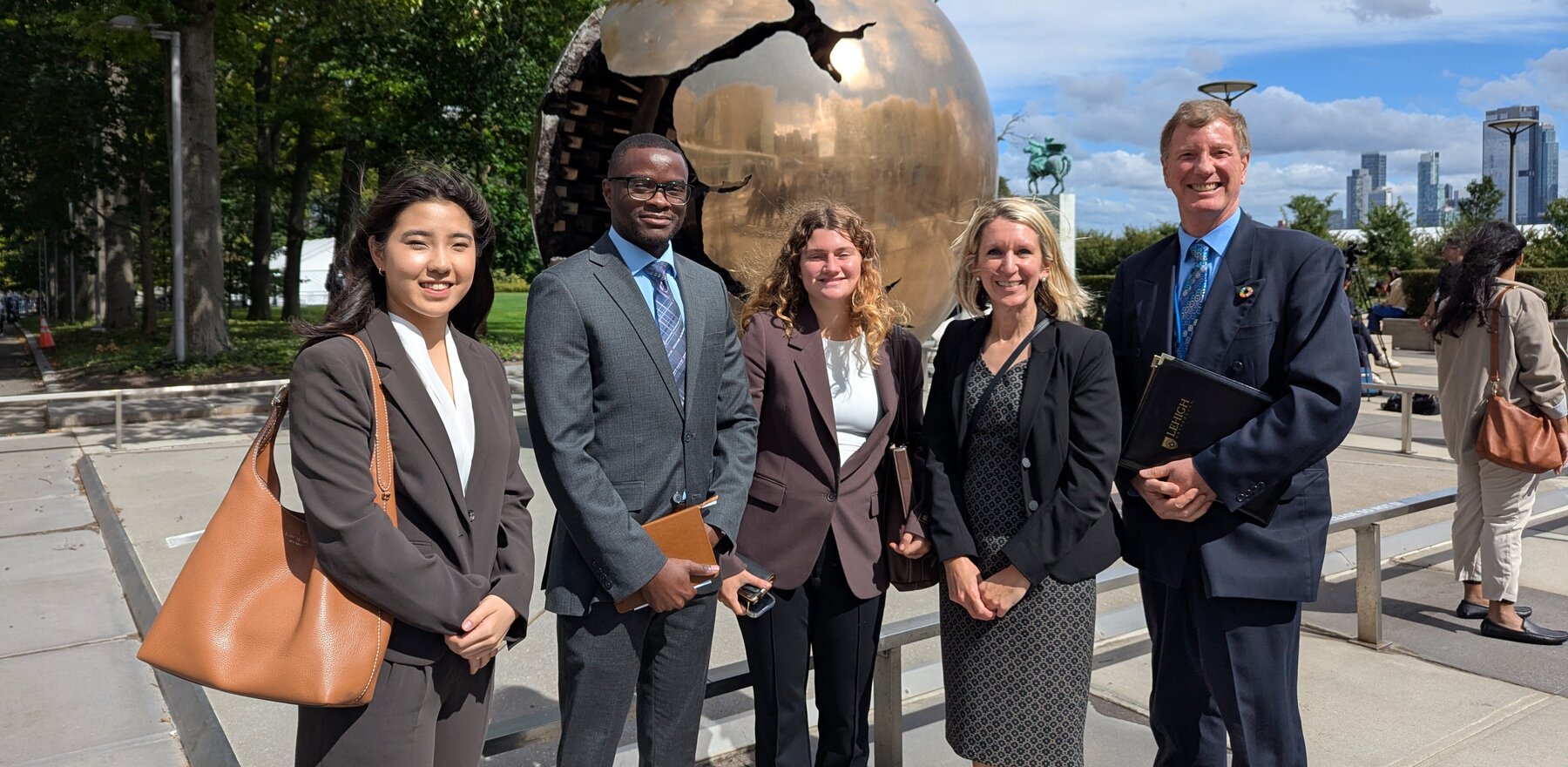
Above in the grand UN auditorium sat five people representing the Lehigh University/United Nations Partnership: Bill Hunter, Director of the LU/UN Partnership; Erica Bobsein, Government Liaison for Lehigh’s Center for Catastrophe Modeling and Resilience (CAT); graduate student Emmanuel Ngambi; and undergraduates Chloe Schunke and Téa Weinstein.
Bobsein, representing CAT at the international event, provided key insights to support the team's ongoing research.
"Attending the meeting offered a valuable perspective on the necessity of natural hazard risk modeling," said Bobsein. "As community planning and critical infrastructure increasingly emphasize adaptation and resilience, CAT's interdisciplinary expertise across climate, vulnerability, and loss modeling serves as the foundation needed to help decision-makers predict, prepare for, withstand, and recover from disaster impacts."
Opening remarks were offered by UN Secretary-General António Guterres, who remarked that the “world is crying out for climate justice.” The globe, he warned, is heading toward an overshoot of the 1.5-degree Celsius warming limit as emissions continue to rise when they must instead “plummet.”
“We don’t have a moment to lose,” Guterres said, pointing to the intensifying effects of global warming.
For Guterres, the path forward requires more than individual countries reducing their emissions. He called for every country to develop a roadmap for transitioning away from fossil fuels while ensuring fairness to communities whose livelihoods depend on existing energy systems.
“No country can de-carbon the global economy alone or shield itself from climate chaos,” Guterres said.
He called for increased adaptation finance, urging governments to incorporate climate resilience into policies and budgets. For developing countries, he emphasized the need to address financial constraints that limit their ability to invest in climate resilience.
His message was ultimately one of implementation: “Deliver, then over deliver.”
This sentiment of action was echoed throughout the summit.
Australian Prime Minister Anthony Albanese pointed out the increasingly visible effects of climate change, including wildfires, storms and record temperatures. For Australia, he said, climate action “starts at home,” citing the country’s goal of a 70% reduction in emissions by 2035.
But Albanese also framed climate policy as an economic issue.
“This is not only about environmental policy, but good macroeconomic policy,” he said, arguing that effective policy can encourage people to participate in the transition. He cited Australia’s expansion of solar energy as an example, saying the transition can also reduce pressure on the country’s energy grid.
Speakers repeatedly returned to the reality that climate impacts are already being experienced around the world.
Glacier collapse in Nepal, extreme heat in Europe and wildfires across the United States and Canada were cited as examples of the consequences communities are already facing.
The urgency became particularly concrete when Nepal’s Minister for Foreign Affairs, Shishir Khanal, addressed the summit.
Nepal has contributed relatively little to global greenhouse gas emissions: the country accounts for less than 0.5% of global emissions. Yet its mountainous geography leaves communities highly vulnerable to climate-related disasters.
“Nepal’s mountains are crying for help,” Khanal said.
Recent flooding has devastated communities, destroying homes, farms and schools and disrupting livelihoods. According to the minister, 1,400 people have lost their lives and 6,000 remain unaccounted for.
“What happened in Nepal was not merely a local tragedy, but a warning to the world of what might be coming next,” Khanal said.
Nepal urges the international response to occur before disasters strike, rather than only afterward. The minister called for accessible climate finance, affordable technology, climate information services and reliable infrastructure.
The remarks brought the summit's broader discussion of climate justice into focus. Countries that have contributed relatively little to global emissions face the most severe consequences of a changing climate, while also having fewer financial resources to prepare for and recover from disasters.
The president of the Republic of Türkiye similarly pointed to recent flooding in Nepal as evidence that climate action can no longer be delayed.
“We must bring ambition closer to capacity and targets closer to implementation,” he said.
That distinction — between setting ambitious targets and actually carrying them out — emerged as one of the summit’s central themes.
For leaders of small island developing states, the urgency of climate change is measured by its immediate effects on their communities.
“For us in the islands, we have been continuing to rally the call that this affects our lives every day,” Mia Mottley, Prime Minister of Barbados, said. “Every fraction of a degree matters.”
Small island states have repeatedly emphasized the importance of keeping global warming within 1.5 degrees Celsius, while also calling for greater access to climate finance, technology and regional expertise.
Mottley argued that small island developing states should not be viewed solely as vulnerable countries in need of assistance, but also as “partners with valuable solutions.”
She focused on the financial limitations facing developing countries, particularly the cost of borrowing and the debt burdens that can restrict governments’ ability to invest in resilience.
For developing countries, she argued, climate resilience cannot wait for long-term financial reforms. Governments need the ability to raise capital and respond to disasters while they are happening, not after the fact.
Among these influential speakers, Lehigh also heard from Fatih Birol, Executive Director of the International Energy Agency; Luís Montenegro, Prime Minister of Portugal; European Commission President Ursula von der Leyen; Fiji’s President Ratu Naiqama Lalabalavu; Tarique Rahman, Prime Minister of Bangladesh; and many others.
For leaders gathered at the summit, the challenge is turning the commitments, targets and financial pledges discussed in the room into measurable actions outside of it.
For graduate student Ngambi, who is studying Environmental Policy with a concentration in Sustainable Development, the conference was a way to translate his academics beyond the classroom.
“Participating in the 2026 UN Climate Summit gave me the opportunity to see my studies come to life on an international stage,” Ngambi said. “Seeing these principles discussed and applied in an international setting made my lessons more tangible and meaningful.”
He said his biggest takeaway is that sustainable development is not simply an idea to study, but an ongoing process of translating policy commitments into practical action.
The summit's message was clear: climate change is no longer a distant environmental problem. It is a pressing issue of energy security, economic policy, infrastructure, finance and, increasingly, survival.
As Guterres put it, the task is not simply to make commitments.
“Deliver, then over deliver.”