Written by Colin McEvoy | May 21, 2026 | SHARE


Student research projects through Lehigh University Office of International Affairs explored the university’s international history, global leadership legacy and the economic impact of immigrant entrepreneurship in the Lehigh Valley.
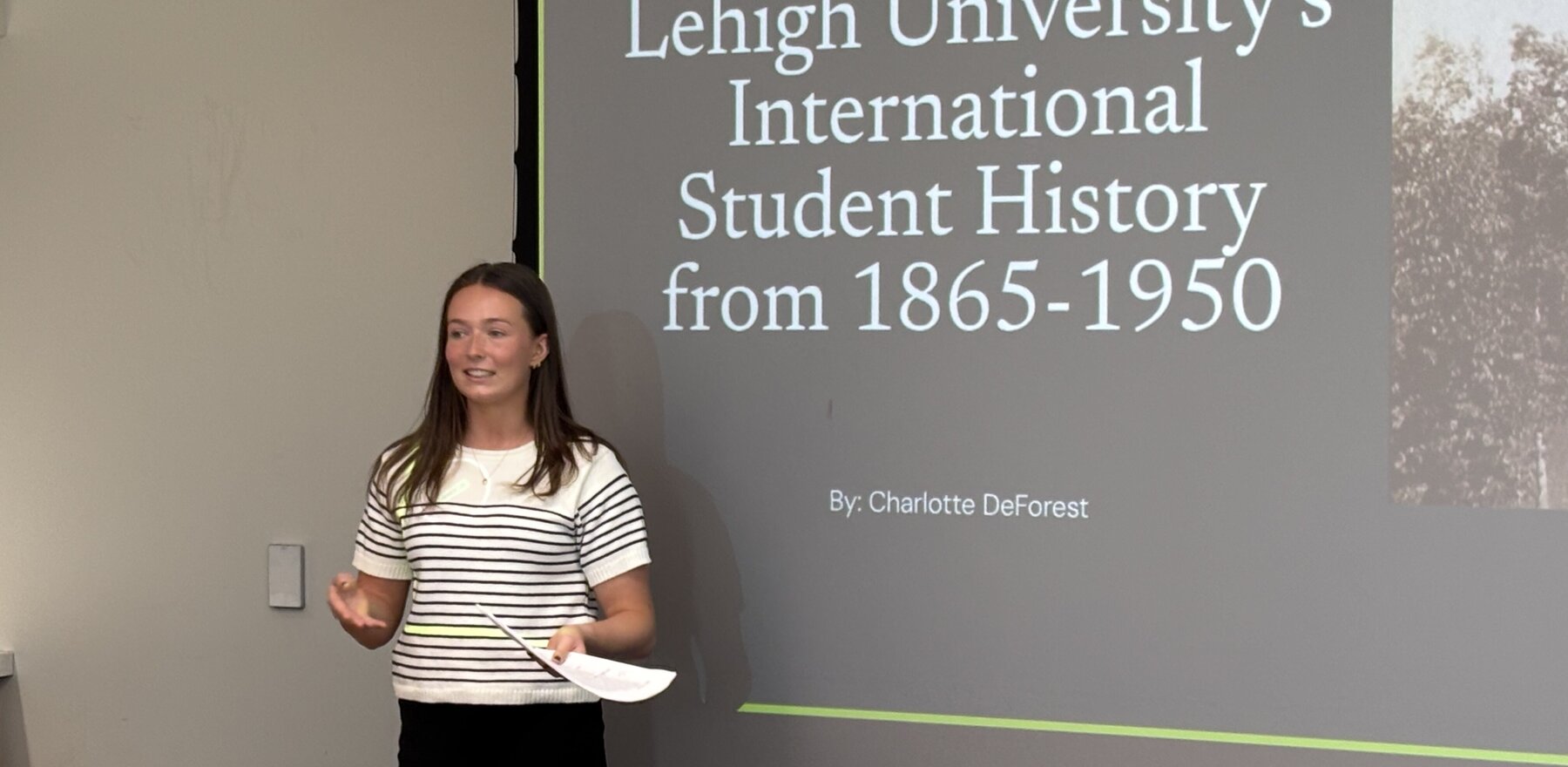
When Charlotte DeForest ‘29 began digging through Lehigh University’s archives, she expected to find records of international students studying engineering in Bethlehem. What she discovered instead was a global history stretching back to the university’s earliest years.
“These students didn’t just come for a degree. They came for the tools to modernize and industrialize their nations,” said DeForest, a first-year student who extensively researched Lehigh’s international student history from 1865 to 1950.
DeForest, who is majoring in political science and economics, transformed her findings into an interactive website exploring Lehigh’s history of international students, featuring maps, archival images, scroll animations, timelines and historical profiles. Visitors can explore the website here, and future student researchers will continue expanding it.
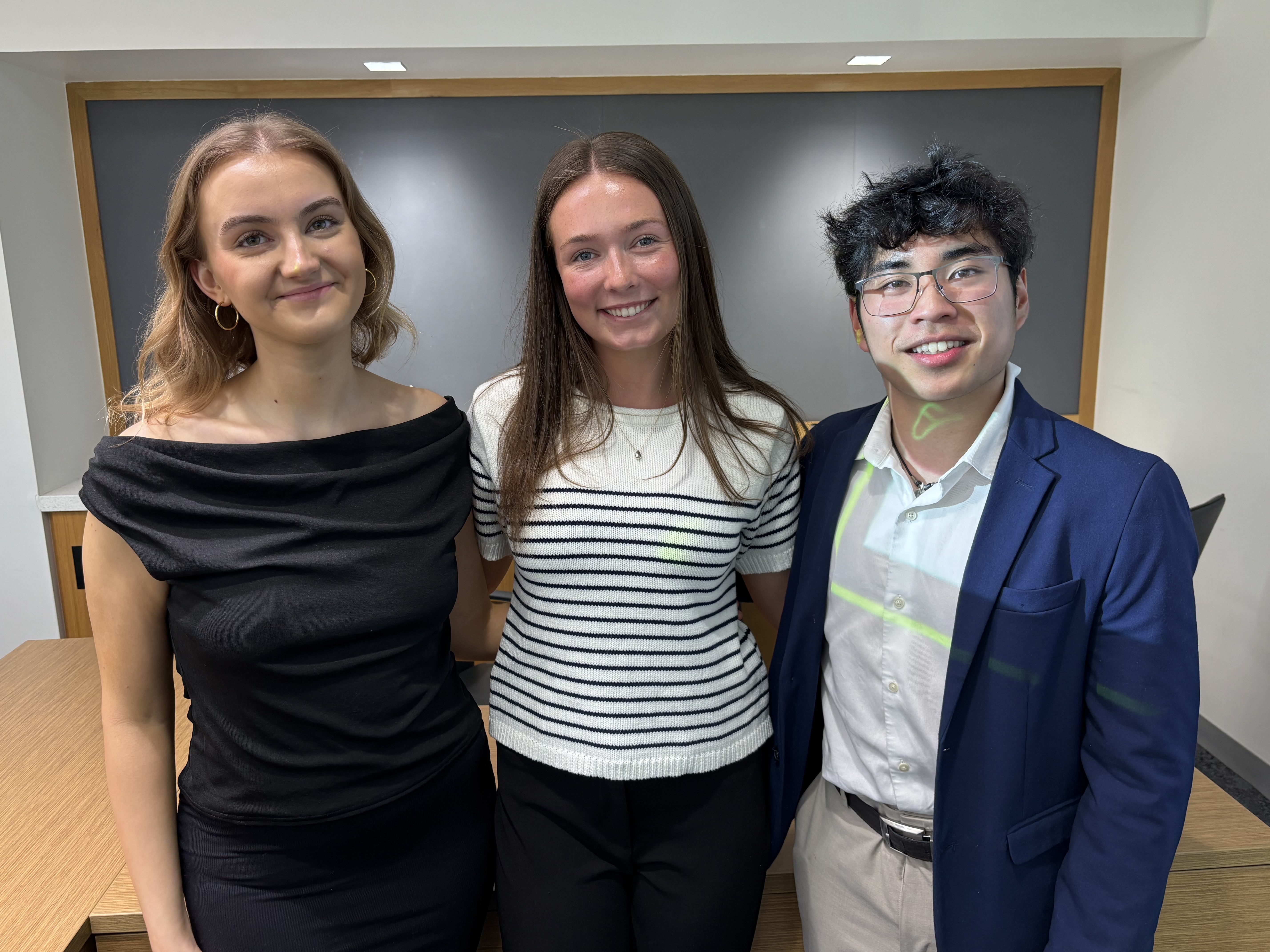
DeForest was one of three student research interns who recently presented their semester-long research projects through the Office of International Affairs (OIA). Other projects included research on Lehigh alum Lee Iacocca’s leadership philosophy and the economic impact of international student entrepreneurs in the Lehigh Valley
“These projects uncovered stories and perspectives that deepen our understanding of Lehigh’s global history and impact,” said Cheryl Matherly, Vice President & Vice Provost for International Affairs at Lehigh University. “The work these students produced will help shape future research, storytelling and programming across the university.”
Additional presentations were given by research interns Lily Cicero ‘28, who is studying international relations and modern languages & literature, and Randelle Agravante ‘28, who is majoring in finance and accounting.
Charlotte DeForest’s presentation
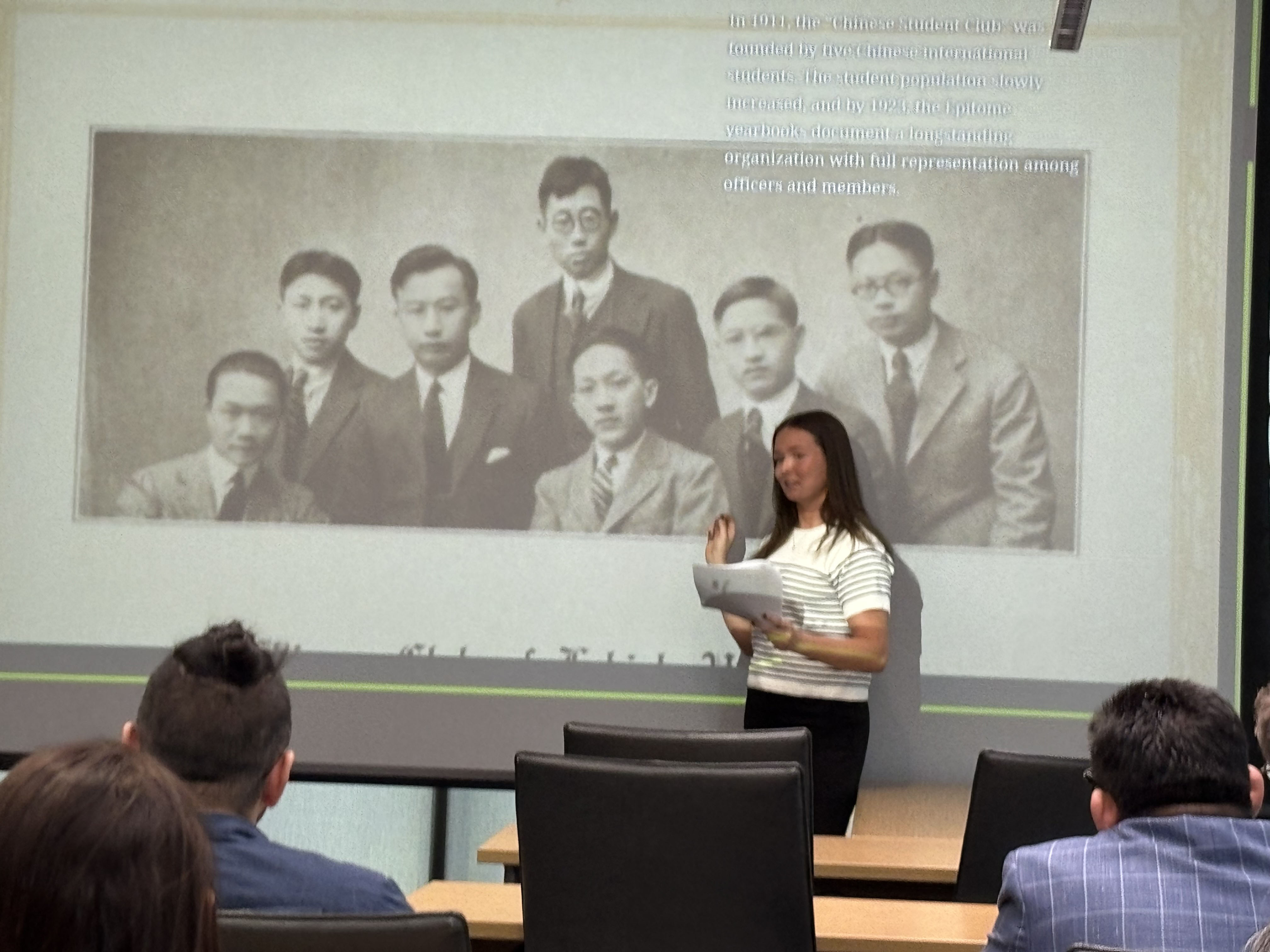
Just one year after Lehigh was founded in 1865, international students had already begun arriving in Bethlehem. DeForest said the university’s first international graduate was a student from Barbados who earned a degree in analytical chemistry in 1869.
Her research found that many early international students came from Brazil, China, Japan and across Latin America to study engineering, mining and railroads before returning home to help modernize infrastructure and industry in their countries.
DeForest also documented the early roots of international student life on campus, including Club Hispano Americano, founded in 1887 and believed to be the first internationally focused student club in the United States, along with later organizations such as the Chinese Student Club and the Cosmopolitan Club.
Using yearbooks, student handbooks and alumni directories, DeForest traced how global events such as the Great Depression and the World Wars sharply reduced international enrollment before postwar growth transformed Lehigh into what she described as “a global hub” for international education and exchange.
Lily Cicero’s presentation
Cicero presented research examining how Lehigh alumnus Lee Iacocca ‘45 communicated and adapted his leadership philosophy in different global contexts. Iacocca led Ford Motor Company’s development of the Mustang and later rescued Chrysler from near bankruptcy.
Her project analyzed more than 75 speeches, along with photographs and media coverage from Lehigh’s Special Collections and the Lee Iacocca Institute for Global Leadership. She particularly focused on speeches because they represented Iacocca’s most intentional and audience-aware messaging to both domestic and international audiences.
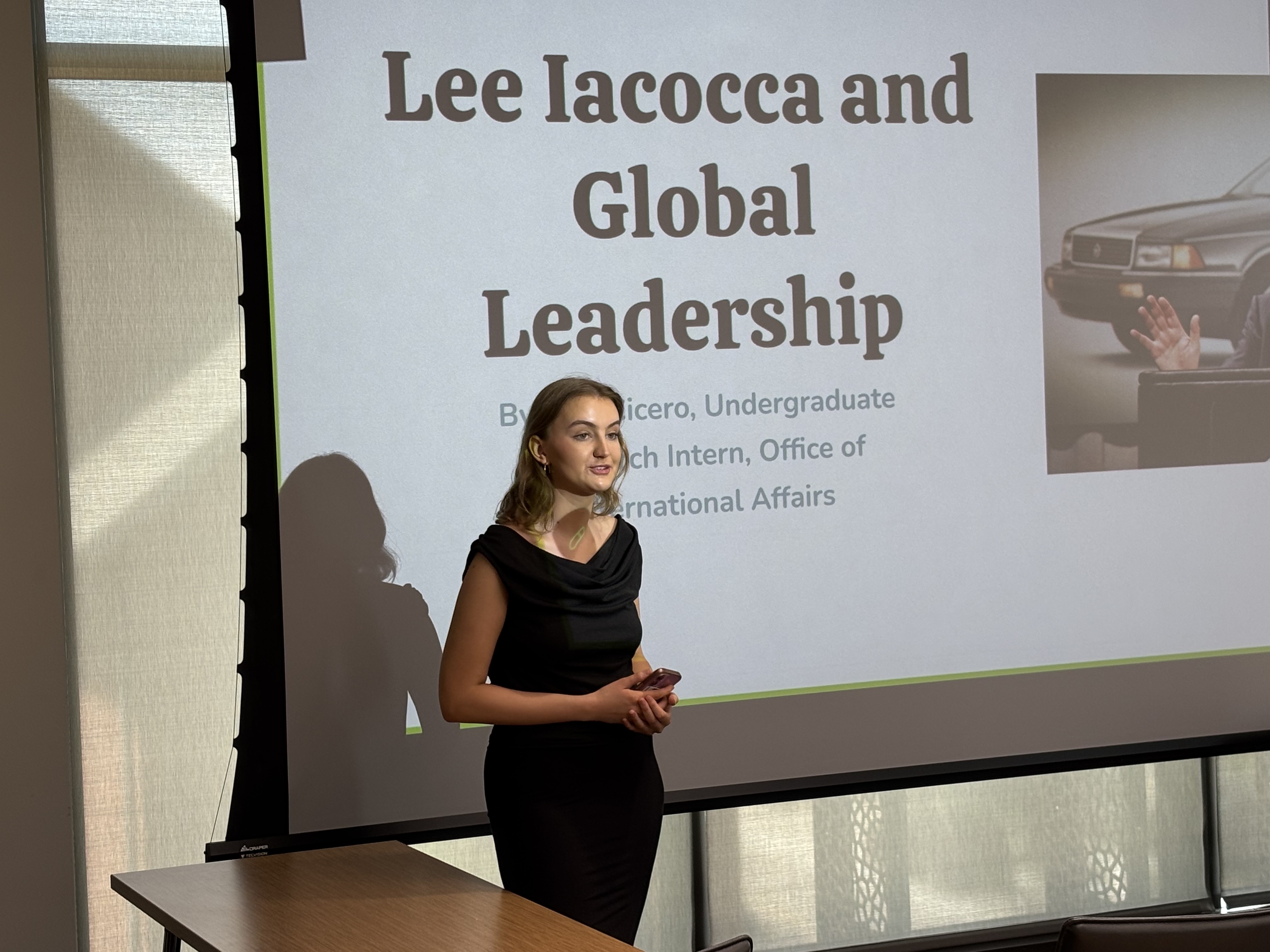
“Leadership is not just about having a specific set of beliefs or traits, but knowing how to communicate that effectively in different contexts,” Cicero said, “Rather than viewing leadership as fixed, I believe (Iacocca) saw it emerging as something dynamic, adaptive, and shaped by both experience and environment.”
Cicero found that Iacocca’s speeches in the early 1980s, particularly those delivered to business audiences, focused heavily on competition, while later speeches increasingly emphasized cooperation, cultural understanding and global interconnectedness.
Randelle Agravante’s presentation
Agravante presented research on the role of international students and immigrant founders in the Lehigh Valley entrepreneurship ecosystem. He found international students and immigrant founders play a major economic role, though he argued more should be done to recognize, track, or support them.
Nationally, 55% of U.S. unicorn startups have at least one immigrant founder, and 25% have at least one former international student founder, Agravante said. He also noted that 46% of Fortune 500 companies have an immigrant founder or child of an immigrant founder.
“Immigrants share the same risk as entrepreneurs,” he said. “They move thousands of miles from their families to a new country without knowing anything, without knowing the new language, and they’re willing to take that same bet.”
Pennsylvania has a low workforce retention rate for international graduates, around 32.5%, despite being among the top 10 states for hosting international students. Agravante argued this means Pennsylvania is losing much of the talent it educates.