Written by Gianna Cusumano | November 3, 2026 | SHARE


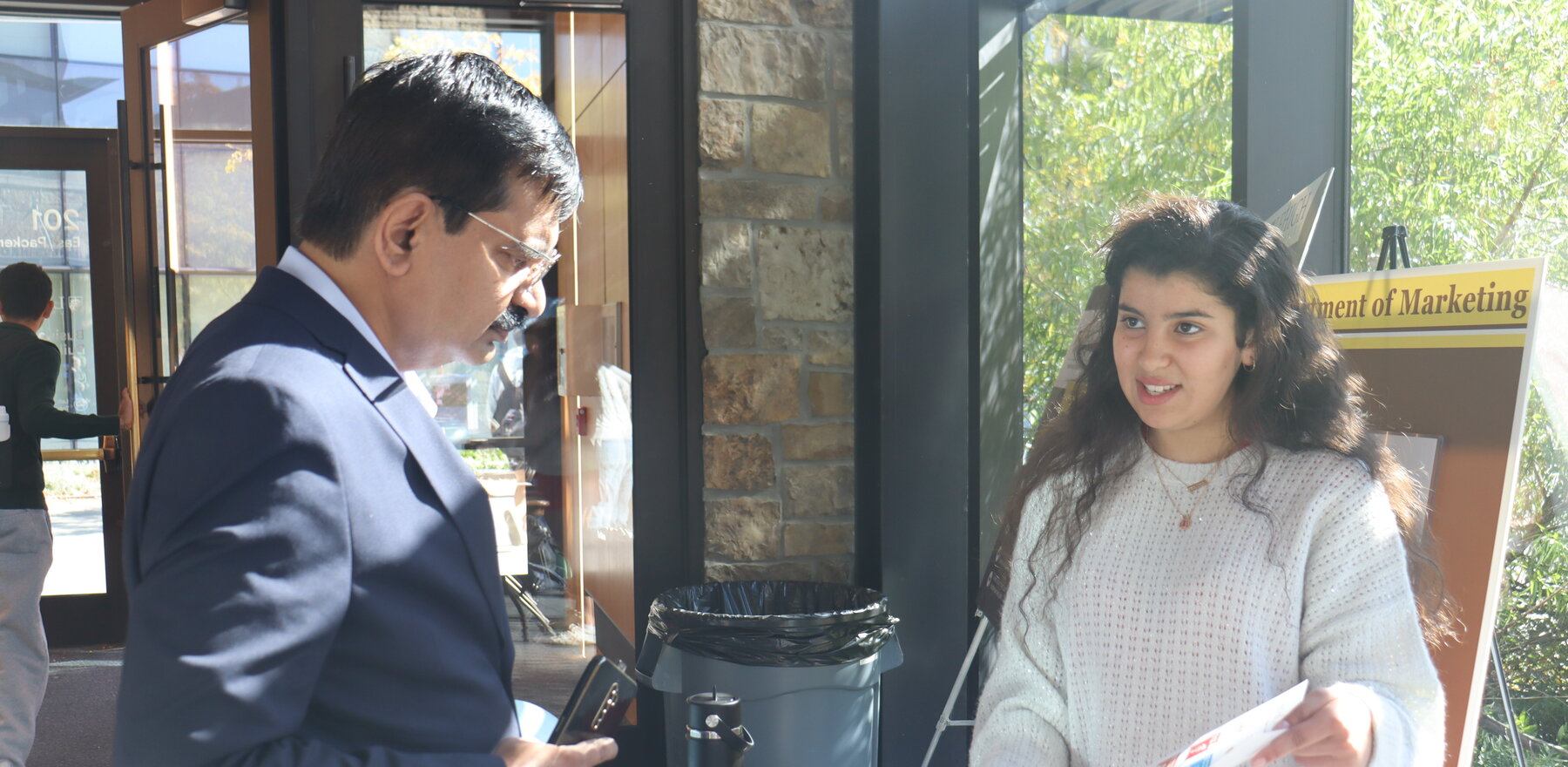
Girish Menon, founder and president of the Nadam Foundation in Kerala, India, visited Lehigh University to meet with student United Nations Youth Representatives and strengthen the organization's partnership with the university.
In Sanskrit, Nadam means “sound.” Girish Menon carefully chose this phrase when founding his humanitarian aid nonprofit, the Nadam Foundation, to reflect his promise to bring both the needs and aspirations of Kerala, India, to the world stage.
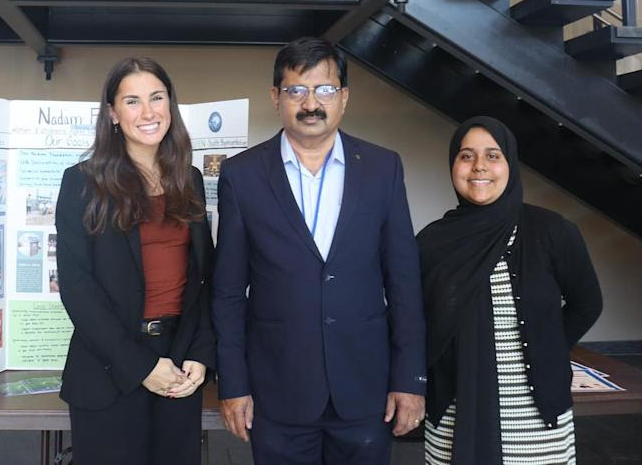
After three years of collaborating with the Lehigh University/United Nations (LU/UN) Partnership, Menon made the 8,544-mile trek from Kerala to Bethlehem. While visiting Lehigh, he met with his United Nations Youth Representatives, Tasfia Ahmad ‘26, and Elizabeth Ehrhardt ‘28, for the first time in person.
Ahmad and Ehrhardt both attended the LU/UN Partnership’s United Nations Day, where they spoke alongside Menon about Nadam’s mission. United Nations Day featured tables and simulation activities from other NGOs involved with the Youth Representative program and Lehigh clubs that connect to the UN Sustainable Development Goals.
Nadam, which uses the framework of the Universal Declaration of Human Rights as its guidepost, advocates for greater gender equity and denuclearization worldwide. Nadam works on many humanitarian causes affecting communities in Kerala; its efforts range from distributing free medical equipment to advocating for stronger environmental policies.
After growing up in a remote village in India, Menon was inspired to create an organization that bridged local needs and global change. Menon was formally trained as a lawyer and sought a job with the United Nations. When he struggled to find work within the UN, he started Nadam in 2010.
“All the doors were closed, so I decided that I’d open my own door. So, I started this organization,” Menon said. “Because of my passion with the UN, I used the principles of the UN to guide it.”
With the start of Nadam, Menon got in touch with a UN Under-Secretary-General through social media, who advised him to apply for accreditation with UN agencies. Nadam is now partnered with the United Nations Department of Global Communications (DGC), the United Nations Economic and Social Council (ECOSOC), and the United Nations Convention to Combat Desertification (UNCCD). These agencies help Nadam expand its international reach and spark global conversations with other non-governmental organizations (NGOs).
A large part of Ahmad and Ehrhardt’s service as Youth Representatives is communicating with Menon about developments in Kerala so that they can better represent the NGO’s interests at the United Nations. Both Ahmad and Ehrhardt were grateful for the opportunity to meet with Menon in person to celebrate their partnership and tour the campus.
“I was really excited to meet Tasfia and Elizabeth. It was a marvelous, wonderful, amazing experience,” Menon said.
Most recently, the Youth Representatives presented at the 70th session of the United Nations Commission on the Status of Women. In addition to presenting Nadam’s work on equity, they engaged NGO leaders, delegates, and other conference attendees in a simulation they called “dream mapping.”
“They had the chance to come to our presentation and create these new maps, which are these actualized, idealistic versions of their community in which they are being climate resilient and focusing on women as part of the solution,” Ehrhardt said. “So it was great to hear from so many global perspectives about how they can better their community in that realm.”
The simulation was inspired by the indigenous women of the Indian state of Odisha, who created “dream maps” to envision their ideal society. In the activity, Ahmad and Ehrhardt encouraged participants to imagine what a society free from sexism and environmental struggle would look like. They then walked attendees through the Nadam Foundation's initiatives.
In her role as a Youth Representative, Ahmad emphasizes the need for clear, consistent communication with Menon.
“He makes sure we are hearing him and constantly know what is happening [within Kerala]. Our job is a lot of communication planning to make sure I am accurately describing what's happening in terms of gender equality within the NGO,” Ahmad said.
Looking ahead, Menon hopes his NGO will keep addressing what he considers the three great problems plaguing the world.
“There is a misuse of three things that cause a real problem. That is misuse of race, religion, and religion,” Menon said.
To address these forms of discrimination, Menon hopes to strengthen his partnership with Lehigh University by engaging more students in Nadam’s mission. This could include hosting Lehigh students and faculty at the NGO sometime in the near future.