Written by Ibtihal Gassem, LU/UN Partnership Intern | February 9, 2026 | SHARE


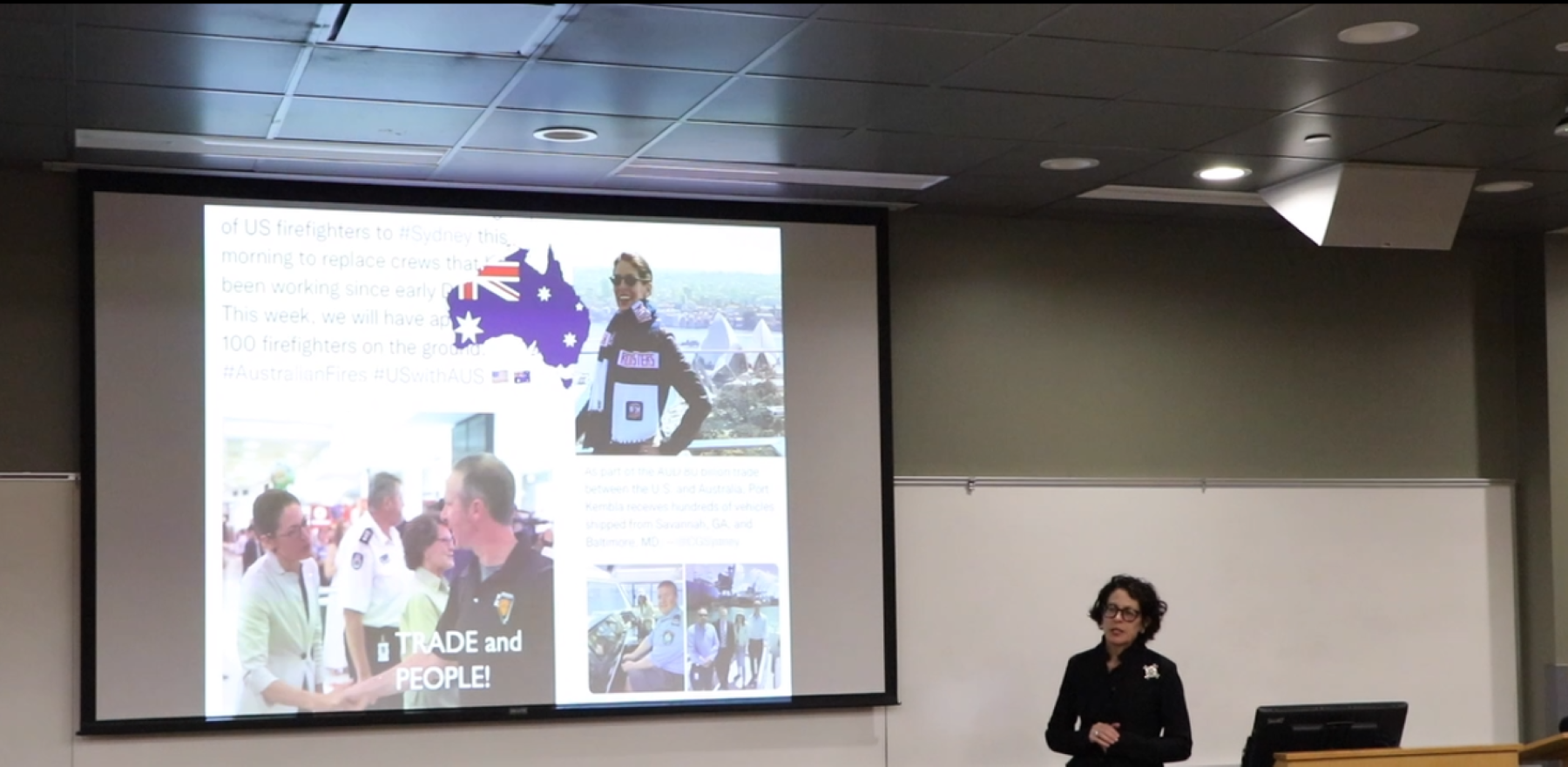
On January 28th, the Lehigh University/United Nations Partnership office, in collaboration with the Political Science and International Relations departments, hosted a candid conversation with Sharon Hudson-Dean titled, “From Australia to Greenland: Implementing U.S. Foreign Policy for Five Presidents.”
A Lehigh Valley native and Georgetown alumna, Hudson-Dean recently concluded her tenure as the Deputy Assistant Secretary in the Bureau of European and Eurasian Affairs. Her career, which spans decades and continents, began in the Japan Exchange and Teaching Programme before taking her to Australia, Russia, and beyond.
During the session, she reflected on her journey from Canberra to Moscow, sharing insights into the evolving landscape of American diplomacy and the personal background that shaped her worldview.
Throughout her distinguished career, Hudson-Dean has navigated some of the most complex geopolitical shifts of the late 20th and early 21st centuries. In Moscow during the late 1990s, she managed exchange programs at a time she described as a high point in U.S.-Russian relations. Her subsequent work in Georgia and Latvia placed her at the heart of Eastern Europe’s struggle for sovereignty and integration into NATO and the EU.
Beyond Europe, her assignments in South Africa and Zimbabwe demonstrated the vital link between humanitarian efforts and national security, as she worked on initiatives ranging from combating the AIDS epidemic to promoting economic development through conservation and constitutional reform.
The conversation then took a sharp turn toward contemporary challenges, specifically regarding the Arctic and the changing nature of U.S. influence. Hudson-Dean highlighted her recent work in Norway and Greenland, emphasizing the strategic importance of the Pituffik Space Base and the Arctic's role in monitoring Russian military build-up.
She spoke bluntly about the "dramatic change" in foreign policy under the current administration, noting that while the Greenland Defense Treaty allows the U.S. significant military and resource flexibility, the approach to these partnerships has shifted. She expressed concern over a move toward a more imperialist style of power that risks alienating long-standing allies, such as the Danish. She emphasized that competing with global rivals like China requires collaboration with the EU rather than isolation.
Addressing the students in attendance, Hudson-Dean advocated for a new generation of diplomats who bring diverse expertise—particularly in energy and artificial intelligence—into the public sector. She warned against leaving the governance of such critical technologies solely to private corporations, arguing that they must be integrated into official policy to protect national interests.
During the Q&A session, she stressed that foreign policy must ultimately strengthen domestic needs, but cautioned that "complete annihilation" of programs like USAID is not a strategic move. She concluded by highlighting the power of public diplomacy, noting that cultural and social programming remains the best tool for building relationships and showcasing American dynamism in an increasingly polarized world.